

American political culture is highly complex and layered, shaped by a dense ecosystem of pressure groups, lobbying networks, corporate law firms, media institutions, and state bureaucracies. These actors often compete fiercely with one another while simultaneously cooperating when strategic interests converge. Washington, D.C. remains the formal seat of federal power, but real influence is distributed across financial center, technology hubs, defence contractors, and global institutions. Control over U.S. political access continues to matter disproportionately, communities, corporations or foreign states lacking effective representation or lobbying capacity in the United States are often disadvantaged on the global stage, one can assume this situation as being politically orphaned.
The United States retains unmatched military capabilities and a vast defence-industrial base, sustained in part by highly skilled migrant labour in science, engineering, and technology. This global talent pipeline supports not only military dominance but also innovation in artificial intelligence, surveillance, cybersecurity, and advanced manufacturing. American power, however, is no longer uncontested, it operates amid intensifying competition over economic, technological, and ideological leadership.
Debate persists over what constitutes the so-called “deep state.” Some observers point to the military industrial complex, others emphasize intelligence agencies, entrenched bureaucracies, Big Tech, financial capital, or transnational elite networks. Rather than a single unified entity, it is more analytically accurate to speak of multiple overlapping power centre, each with its own incentives, rivalries, and degrees of influence. Popular narratives ranging from secret societies to shadow governments reflect widespread mistrust of opaque institutions, even if they often oversimplify how power actually functions in practice.
Billionaire donors and corporate interests rarely align rigidly with one political party. Instead, many hedge their influence by funding both Democrats and Republicans, adjusting their support according to regulatory priorities, foreign policy preferences, or sector-specific concerns. This bipartisan financing is an interest-driven nature of elite political engagement.
Social media has intensified polarization in what is often described as a post-truth political environment. Cultural divisions have hardened along lines of geography, class, race, religion, and identity. Rural and semi-urban populations, along with segments of the middle-class nationalist base, tend to emphasize and support family structures, religious values, national sovereignty, and law and order politics. In contrast, progressive and urban spaces often overlapping with academic, activist, and professional networks prioritize issues such as gender identity, reproductive rights, LGBTQ protections, wealth redistribution, and expanded social welfare. Critics on the capitalist or conservative side frequently frame these agendas as socialist, communists, anarchic, or destabilizing, while supporters view them as extensions of civil rights and social justice.
The two major parties do not divide cleanly along foreign-policy lines, though differences in emphasis exist. Both Democrats and Republicans broadly support Israel, though they diverge in tone, conditionality, and diplomatic style. Similarly, both parties maintain deep ties with Europe, even as internal disagreements persist over NATO burden-sharing, trade, and multilateral governance. On China, the gap has narrowed significantly, while Democrats often stress alliance-based competition and institutional engagement and Republicans emphasize economic nationalism and strategic decoupling, both increasingly view China as the primary long-term challenger to U.S. power.
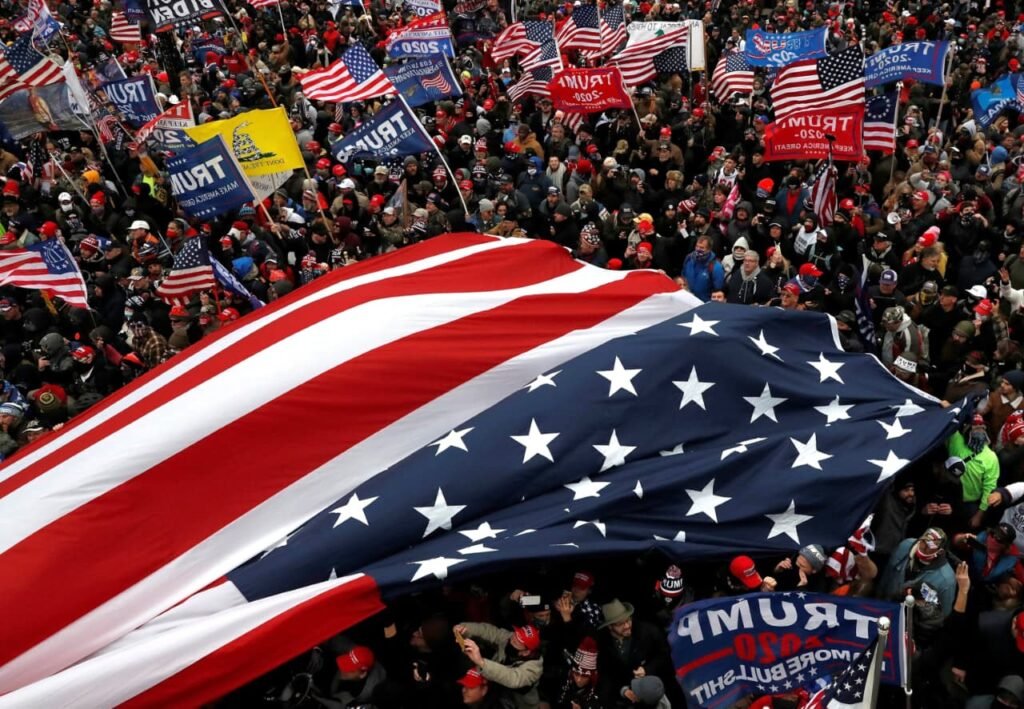
A significant segment of the American electorate galvanized during the Trump era remains committed to resisting globalization, citing deindustrialization, job losses, rising crime, and perceived erosion of national sovereignty. Trump’s political success reflected not only personal appeal but also deep structural grievances, particularly among working-class and lower-middle-class voters. His administration sought to reduce certain forms of international entanglement, confront China more directly, tighten migration policies, and challenge global frameworks such as the United Nations’ Sustainable Development Goals, which supporters viewed as constraints on national autonomy.
From outside the United States, perceptions vary widely. To some Europeans and Indians, America appears fragmented or in relative decline, to Chinese strategists it remains a powerful but increasingly hostile rival, to Israel it continues to be a crucial strategic ally. To many middle-class Americans active on platforms like Truth Social the country is reclaiming strength and sovereignty. To others, it seems increasingly isolated and internally divided. These contrasting views highlight how assessments of American power are deeply shaped by positional, ideological, cultural and geopolitical context.
Whether the United States is truly in decline remains an open question. Its institutions face debt to gdp strain, its social cohesion is under pressure, and challenges such as de-dollarization, technological competition, and geopolitical realignment loom large. Yet its economic scale, military reach, innovation capacity, and cultural influence continue to give it resilience. The outcome will depend less on any single election or leader than on how effectively the United States adapts to a rapidly transforming global order.