

The World Economic Forum in Davos, Switzerland, founded by Klaus Schwab, is referred as a ‘Globalist’ consortium by the political right, often called a shadow government. Yet it remains one of the rare convergence points where heads of state, central bankers, global corporations, and long-term capital allocators, intellectual elites and billionaires gather to discuss how power, production, and technology will be structured decades ahead. What emerges from Davos is not policy, but discussions and direction that millions of people are affected by.
Historically, world orders have always followed economic engines. After World War II, Europe openly spoke of a “new world order,” one that placed the United States at the visible center of global power. Oil became the new gold, the dollar its pricing mechanism, and the petrodollar system transformed America into the epicentre of global finance and security. Even then, much of the industrial capital, manufacturing expertise and legacy wealth that helped construct this order remained rooted in Europe. Today, similar language has returned at precisely the moment the foundational energy system of the global economy is shifting once again.
Sustainable and renewable energy is emerging as the next strategic driver. Electric vehicles, solar manufacturing, hydrogen, battery storage, semiconductors, and clean industrial supply chains are steadily replacing oil as the primary axis of long-term growth. This transition structurally favours regions with scale, workforce depth, cost efficiency, and policy adaptability. Asia’s rise, therefore, is not ideological, it is logistical. Two giants, India and China, possess vast human capital, governance frameworks, and industrial ecosystems capable of manufacturing at global scale. As a result, clean technology investments and production are gravitating eastward. This shift naturally unsettles entrenched interests in the United States, particularly traditional oil energy industries and segments of the American middle class, because it signals a gradual relocation of economic gravity, employment, and industrial leverage.
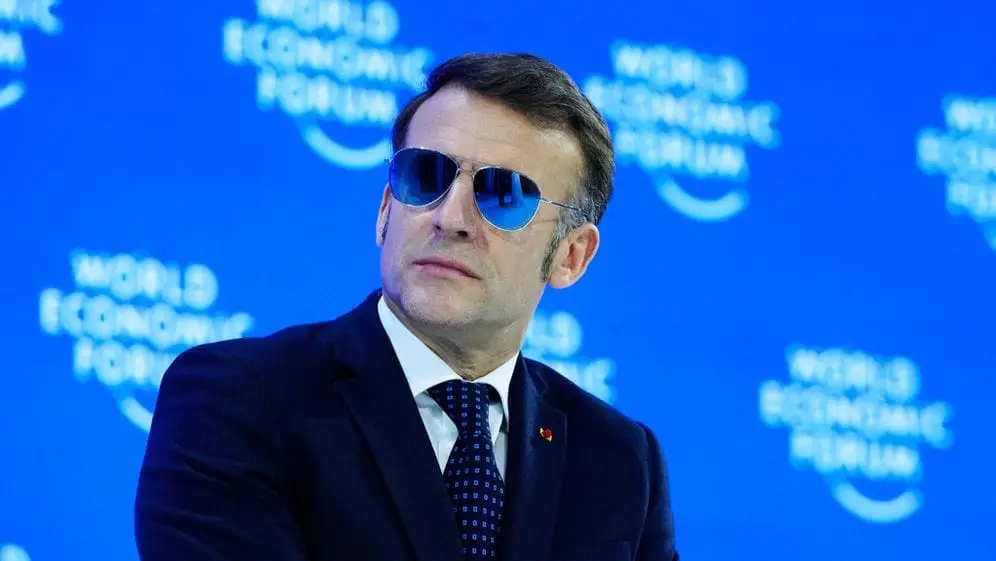
The European Union, however, appears to be recalibrating earlier and more deliberately. French President Emmanuel Macron at WEF stated, “China is welcome, but what we need is more Chinese foreign direct investments in Europe, in some key sectors, to contribute to our growth, to transfer some technologies, and not just to export towards Europe, some devices or products which sometimes don’t have the same standards, or are much more subsidized, than the ones being produced in Europe” is not diplomatic pleasantry, it is industrial strategy. European Commission President Ursula von der Leyen’s remark about signing the “Mother of all deals” with India reflects a growing recognition that Europe’s future competitiveness depends on deep integration with Asia’s growth engines. Estonia’s former Prime Minister and current Vice-President of the European Commission , Kaja Kallas, along with the entire EU leadership team traveling to India for Republic Day in January 2026, signals a strategic pivot that is both political and economic, where India and European Union might declare a ‘Free Trade Agreement’.
What is emerging is not a replacement of alliances, but a rebalancing of them. India already maintains bilateral relations with the United Kingdom, has recently signed free trade agreement, with France in defence and energy and MOUs in fintech, with Germany in manufacturing and technology and with Italy and others in industrial cooperation. European Union post-colonial and post-Cold War, is rediscovering the India as a strategic and economic theater after decades of Atlantic-centric alignment with the United States. The engagement is framed as business between equals, like-minded nations, with less hierarchy and more partnership.
The logic is straightforward, every new world order consolidates around investment flows, technological leadership, and policy readiness. Nations that align governance, capital, and human logistics early do not wait for permission, they become indispensable. The U.S. centered world order is not collapsing, but it is changing. When U.S. Commerce Secretary Howard Lutnick remarked at the World Economic Forum that “globalization has failed the West,” he articulated domestic political pressure rather than global reality. European Central Bank President Christine Lagarde’s visible disagreement followed by a walk out in that moment symbolized more than a policy dispute, it revealed a widening divergence in how Europe and the United States interpret globalization’s future.
This does not signal an imminent rupture in transatlantic relations, but it does indicate strain. The United States’ foreign policy increasingly favors selective decoupling and industrial protection, while Europe seeks diversification through Asia to avoid strategic economic stagnation.
The emerging New World Order, therefore, is not anti-American. It is post-exclusive and multipolar.
Asia is positioned to lead production and growth. Europe is positioning itself to fuel that growth through capital, regulation, and technology partnerships. The United States is negotiating its role not as the sole architect, but as a powerful participant adapting to a multipolar economic reality shaped by a new energy era.
History shows that world orders rarely end abruptly. They evolve unevenly, contested at every step. Davos reveals consensus in formation, the center of gravity is shifting, and those who adapt early will shape the rules of what comes next.
The strongest objection to this stance is that the United States still controls the world’s decisive levers of power: the dollar, global capital markets, military reach, and frontier innovation. That objection is valid, but counter-arguments suggest that, reserve currencies do not collapse, they erode. Industrial dominance does not disappear, it migrates or reverse migrates. The United States remains unmatched in financial depth and technological breakthroughs. Yet these advantages increasingly coexist with offshored production, fragmented supply chains, and rising industrial competition. Power in this era is no longer monopolized by whoever invents first, but by whoever can scale fastest, manufacture most efficiently, and deploy globally criteria that increasingly favour Asia-linked ecosystems over any single Western state.