

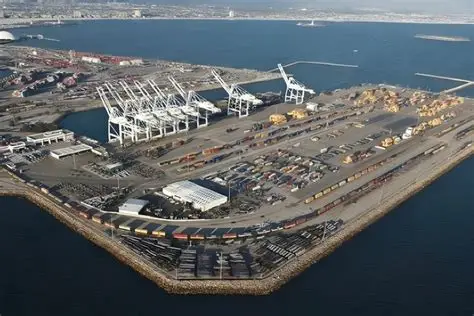
The main point of centre between India-Iran relations is Chabahar port which both the nations saw, agreed to work together to reinvigorate their relations to a new height in the trade domain through joint framework. The first contact to develop Shahid Behesti port of Chabahar formalized in the year 2003, but in the wake of US sanctions on Iran imposed after the 1979 Revolution stalled the progress further. As the new government in India took the charge in the year 2014, Prime Minster Narendra Modi paid 2-day visit to Iran in May 2016 where he met his Iranian counterpart President Hassan Rouhani with whom he held a wide range of talks of subjects focusing on bilateral trade, people to people connect, mutual cooperation, promoting peace and stability in the region. A total of 12 agreements were signed with commitment of investment worth $500 million to develop Chabahar port to boost trade relations revolving around oil deals and connectivity, after 2003 this was the latest point of contact between the two nations on the issue after a gap of 13 years which saw negligible progress during that span of time. India used to import a huge chunk of oil from Iran after the sanctions on Iran were partially lifted under JCPOA ( Joint Comprehensive Plan of Action Plan) where Iran agreed on inspection of its nuclear facilities and setting a cap on uranium enrichment but in 2017 sanctions were reimposed in Iran due to alleged being non complaint to IAEA (International Atomic Energy Agency) standards and the clauses defined under JCPOA.
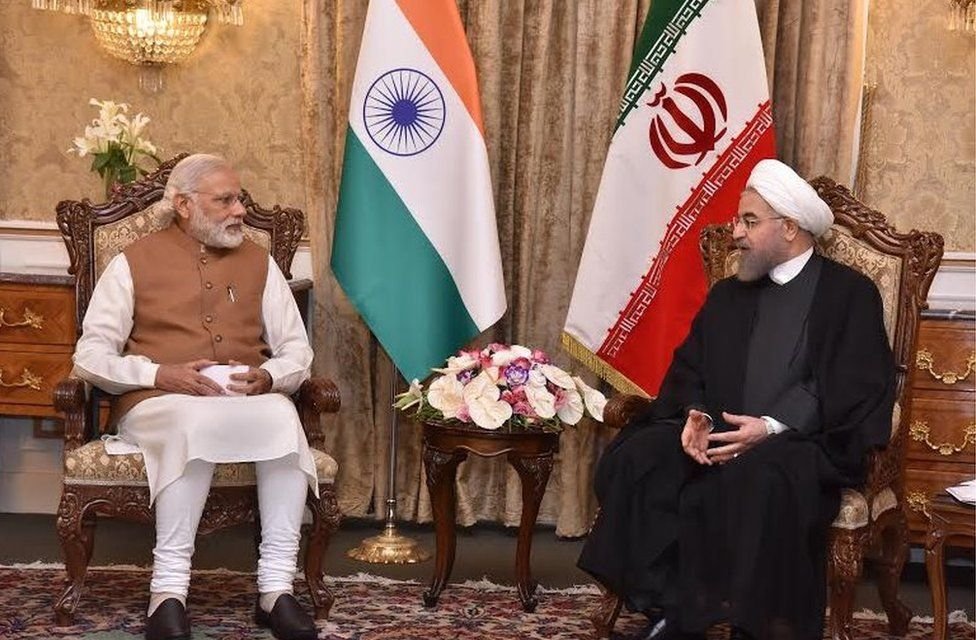
Pic-1.:- Indian Prime Minister Narendra Modi with his Iranian counterpart President Hassan Rouhani during his 2-day visit in May,2016.
Due to this, India had to stop its purchase of Iranian oil. The bilateral agreement on Chabahar would allow India to refurbish the shipping berth at Shahid Beheshti port and construct a 600 long container handling facility as India got a sanction waiver from the US regarding it which is going to expire in the year April 2026. Chabahar is also a nodal point of INSTC (International North-South Transport Corridor) a pilot and multi alignment project framework to connect Central Asian and Eurasian markets to India for smooth passage of import and export of goods including oil and gas boosting strategic outreach and presence of India in that region through active engagement connecting two major economic hubs Mumbai and St. Petersburg of Russia. Apart from it India also started developing Zaranj-Delaram Highway under financial support by India’s BRO (Border Roads Organization). In October 2017, India sent goods to Afghanistan through Chabahar expanding its reach, but the catch also lies that Chabahar was also seen as counter to Gwadar port in Baluchistan being developed by China under CPEC (China- Pakistan Economic Corridor) arrangement with Pakistan and India had to act decisively to send messages to both through its presence in Iran. India also planned to expand Chabahar port connectivity by constructing a railway link between Chabahar and Zaranj of length 900km under a cost of $1.6 billion signed in 2016 but the project took the hit of sanctions in 2019 from the US and remains incomplete after which in 2020 Iran solely took the responsibility to complete the project on its own. In 2016, Afghanistan also joined the trilateral arrangement with both India and Iran which revolved around Chabahar with a joint cost $21 billion of investment. The route also resulted in 60% reduction cost in shipment and 50% reductions turnaround time of ship for India in terms of trade. The security implications on Chabahar are also huge as a potential attack from several terror organizations which would have created huge damage to India’s efforts.
Chabahar has been nodal point as well as gateway to Central Asia connecting two major hubs Mumbai and St. Petersburg through ship, railway, and roadways link spanning around 7200 kms under INSTC agreement in 2002 including members India, Iran, Azerbaijan, Armenia and Russia which also synchronized with Ashgabat agreement which India signed in 2018 posing a best suitable alternative to traditional Suez route significantly cost effective along with saving travel time.
Contemporary Scenario:
For FY 2026-2027 India unveiled its latest budget which included foreign aid to nations including investments regarding India’s ongoing projects in various nations, one strategic silence stood out- the absence of any clear push for Chabahar port and further investments, once envisioned as part of India’s strategic outreach with Iran and Central Asia due to looming threat of US sanctions and ending of waiver in April 2026 casting a long shadow on India’s efforts and engagement reducing Chabahar to a symbolic commitment. As New Delhi is calculating the cost associated with every such component regarding it as it is also part of strategic arrangement with the US and Israel while navigating the constraints and adopting a risk averting approach for it resulting in a policy paradox. India is following the Doctrine of strategic autonomy will be able to sustain it but If push comes forward from the US to India to abandon the project. It is in speculation that India has just taken a pause for Chabahar not officially announcing its exit from it. In case India also needs to balance it’s interests if a new regime comes forward to take over Iran like the same it did with Afghanistan regarding Taliban completely successfully securing it’s interests. China currently buys 90% of Iranian oil despite the international sanctions on Iran. US should reconsider and to agree with a concession arrangement with India’s interests regarding Iran and which would also benefit Washington for their reach to C5 nations under it. Changing equations in Iran would potentially bring new opportunities for India to recalibrate her stakes in Iran especially with regards to Chabahar, if the Iranian regime changes.