



Nepal, often called The Himalayan Kingdom, is nestled between two Asian giants whose power rests on both economic strength and military might — China in the north and India in the south. This positioning makes Nepal more than just a small nation; it is a buffer state, walking a tightrope between competing influences and being inevitably drawn into the great-power politics of its neighbors. Its sovereignty is constantly tested by the push and pull of these external forces, yet its identity remains deeply rooted in its geography and culture. The nation stretches across a breathtaking landscape that rises from the lush green plains of the Terai to the terraced hillsides and finally to the snow-capped ranges of the Himalayas. These mountains are not only symbols of natural beauty but also act as a fortress, a vanguard that has historically shielded Nepal from external conquest. The rivers born of these peaks — the Ghaghra, Gandak, and countless others — flow downstream through fertile valleys, sustaining agriculture and livelihoods while connecting Nepal’s terrain to the broader South Asian ecosystem.
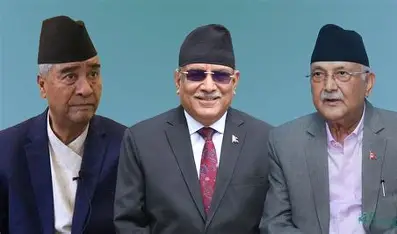
But the nation went into chaos last year 2025, when protestors took the streets leading a huge massive protest against the govt. The protests of 2025 began with a spark: the KP Oli government’s decision to ban 26 social media apps, including Instagram and Facebook. This move, combined with growing frustration over political nepotism and elitism, ignited widespread anger. Government officials and bureaucrats were seen enjoying lavish lifestyles while ordinary citizens struggled, deepening the sense of injustice. The call for the restoration of democracy was rooted in the belief that power should rest at the doorstep of the people. Instead, it had become a personal tool in the hands of a few individuals, manipulated to serve their own choices and preferences in pursuit of political endgames. In 2008, Nepal emerged from the wreckage of a decade-long civil war with the promise of parliamentary democracy. For centuries, the monarchy had been the soul of the nation’s identity, but the ground beneath it began to crumble in 2001. The Royal Massacre, in which Crown Prince Deependra killed King Birendra, Queen Aishwarya, and several members of the royal family before taking his own life, shattered the aura of invincibility surrounding the crown. The throne passed to King Gyanendra, who in 2005 seized absolute power by dismissing parliament, jailing politicians, silencing journalists, and declaring emergency rule. Massive protests followed, and the civil war — led primarily by communist insurgents — escalated into a nationwide conflict that claimed thousands of lives. The demand was clear: the abdication of the king and an end to imperial rule. After nearly 250 years of monarchy, Nepal was declared a republic in 2008, dissolving imperial rule and promising democracy, accountability, and governance chosen by the people through the ballot box. Yet the promise quickly soured. In the 17 years since, Nepal has witnessed 15 governments, many lasting less than a year. Power has revolved among three dominant leaders — Sher Bahadur Deuba, Pushpa Kamal Dahal “Prachanda,” and K.P. Sharma Oli — who repeatedly form alliances with one another to keep the third at bay. This revolving door of prime ministers has exposed the fragility of Nepal’s political system: governments toppled by shifting sides, unstable leadership, and alliances forged purely for power rather than policy. The consequences have been devastating. Corruption has become endemic, inflation has soared to record levels, unemployment remains in double digits, and the economy struggles to find footing. What was once envisioned as a new dawn of democracy has instead become a cycle of instability, where the promise of people’s power has been overshadowed by political gamesmanship and the relentless pursuit of control. The motive for restoration of democracy was that power should have been at the doorstep of the people but the case was totally different rather it became the personal tool in the hand of those individuals who were calibrating as per their own choice and preferences for their political endgame.
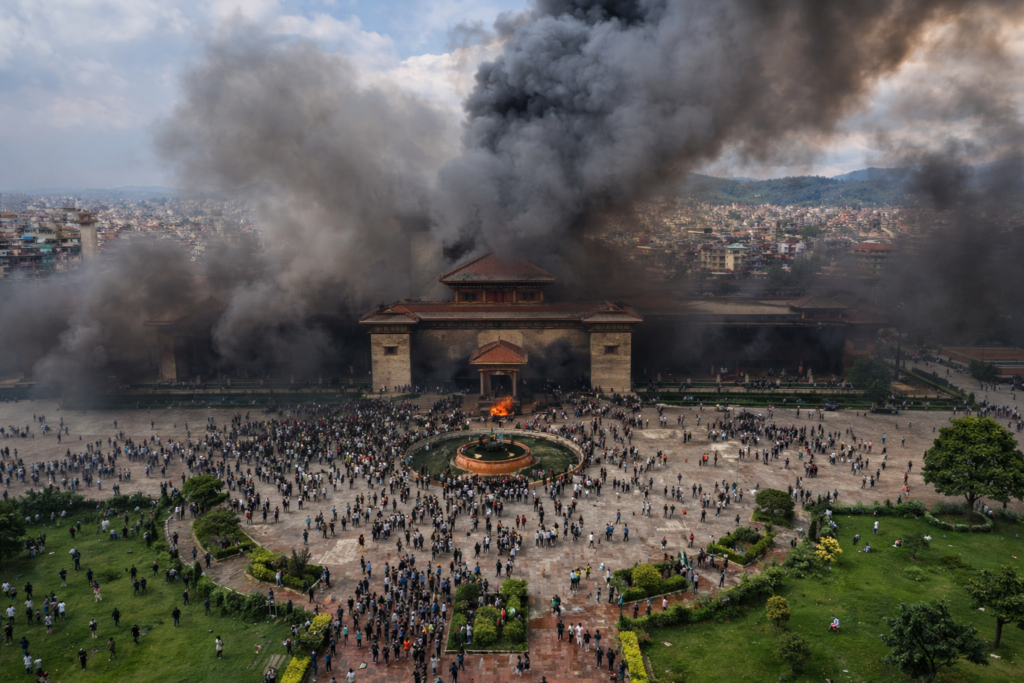
In 2025, nearly 770,000 Nepalese youths left the country in search of employment and a better livelihood, driven by economic hardship and political chaos at home. Their departure underscored a deep mistrust in the system, a sentiment that soon erupted into nationwide protests. Commonly known as the Gen‑Z protests due to the overwhelming participation of young people across the Himalayan Kingdom, including in the capital Kathmandu, these demonstrations reflected years of simmering anger and frustration. The protests met with a heavy police crackdown and quickly turned violent. Seventy‑seven people were killed, including the wife of a former prime minister. In retaliation, protestors set fire to multiple government and administrative buildings, including the Presidential Palace and Parliament. Former prime ministers, ministers, and officials were beaten and humiliated in public. As the situation deteriorated, the government collapsed, and an interim administration was formed under the leadership of Sushila Karki, chosen directly by the protestors to oversee the country until the general elections scheduled for March 2026. Her nomination was backed strongly by the Gen‑Z movement, largely due to her reputation for anti‑corruption rulings. In a unique process unprecedented anywhere in the world, around 120,000 young people assembled virtually on social media and the gaming chat app Discord, where her name circulated as a potential interim leader. They voted for her on that platform, effectively crowning her as the protestors’ choice. Meanwhile, in April 2025, another wave of demonstrations emerged, this time demanding the restoration of the monarchy. Supporters rallied around portraits of Nepal’s first ruler, King Prithvi Narayan Shah, signaling significant backing for former deposed King Gyanendra from certain sections of society. Following her nomination as interim leader, Indian Prime Minister Narendra Modi congratulated Sushila Karki in a telephonic conversation, exchanging greetings and expressing support for her efforts to bring stability to Nepal.
Impact on India-Nepal ties and China angle...
The relation between the two nations is defined as the relations of Roti-Beti, the ties dates back from the reign of Licchavis. India has been a first responder in time of need, the biggest example was HADR assistance in 2015 Nepal earthquake. New Delhi has also been consistently engaging with Kathmandu on various areas of cooperation- Military, Health, Education and hydel projects as Beijing started making inroads into the nation through pitching its ambitious BRI(Belt and Road Initiative) to pose a serious security challenge to New Delhi and its interests. India always tried to keep Nepal on its sides through proactive engagement. But the relations between the two nations started deteriorating from 2015 Madhesi protest and it hit all time low when K.P. Sharma Oli was PM of Nepal, due to his anti-India statements, including his closeness to China and actions just to divert the attention of not resolving the country’s primary problems like unemployment, inflation, economic hardships and young talent leaving the country for better scope for employment and livelihood and picking up fight against its friendly neighbor India. One of the actions he ignited was baseless claims over the three so called disputed territories of Lipulekh, Kalapani and Limpiyadhura of India which he claimed to be the part of Nepal’s sovereign territory. Under his directions, Central Bank of Nepal minted new currency notes showcasing those three territories as part of Nepal vilifying India as an aggressor and since the those notes are in the mainstream circulation as no other PM decided to pull back the decision which Oli took in the year 2020 since then it has become a sticky point in India-Nepal relations. Nepal under Oli has constantly teamed up with China over the projects of BRI which was a tool of China’s debt trap diplomacy and known for embezzlement of billion of dollars of funds highlighting the corruption angle including both the sides as per the report presented in Nepal’s Parliament, one of them was Pokhara International Airport, keeping this challenge into the India strict ban of flight taking off from this airport.
Nepal voted for once again…..
In 2026, months after the mass Gen‑Z protests, Nepal went to the polls on March 5 with renewed hope and active participation. Voters sought change beyond the three traditional contenders — the Nepali Congress, CPN‑UML, and CPN (Maoist) — leaving the field open for a new force to replace the interim government. The election proved to be one of the most interesting in recent history. When results were announced, the Rastriya Swatantra Party (RSP), led by Gen‑Z figure and former mayor of Kathmandu Balen Shah — a rapper turned politician — secured more than a two‑thirds majority. It marked the first time since the 1991 election that a party outside the dominant trio received such overwhelming support and a clear mandate from the people, with Shah elected as the new Prime Minister of Nepal. Our PM Narendra Modi congratulated him for taking the office and show his utmost desire to work together to strengthen the partnership between the two nations as India has always advocated for free and fair election as per constitutional norms of Nepal taking people into the confidence. Since new PM of Nepal has entered the office he issue several orders including arrests of politicians- former PMs- Oli, Deuba and Prachanda along with several of former ministers, anti corruption crackdown and full comprehensive review on China’s BRI projects in Nepal. China’s closeness and preferences for earlier govts encouraged anti-China sentiment in Nepal, where in mid-March 2026, anti-China protest erupted in a technical college in Morang dist. of Koshi province burning the copies of book written by Chinese President Xi after which Chinese officials lodged their dissatisfaction against it, also cancellation of 5G Huawei’s telecommunication projects and alarmed them about growing anger against them.
What India should do?…
As Nepal’s new government takes charge, India should seize the moment to reset ties and build a forward-looking partnership. The relationship has often been strained by territorial disputes and mistrust, but this is an opportunity to move beyond old grievances. India can frame its outreach around shared civilizational bonds, emphasizing cultural and historical ties that transcend politics. At the same time, it should position itself as a reliable economic partner, offering investment, energy cooperation, and employment opportunities that directly benefit Nepal’s youth — the driving force behind recent political change. By supporting Nepal’s sovereignty while encouraging balanced development, India can counter external pressures and reinforce the Himalayas as a zone of peace. Most importantly, India should engage directly with Nepal’s younger generation, whose activism has reshaped the country’s politics, signaling that New Delhi stands with them in building a democratic, stable, and prosperous future.