



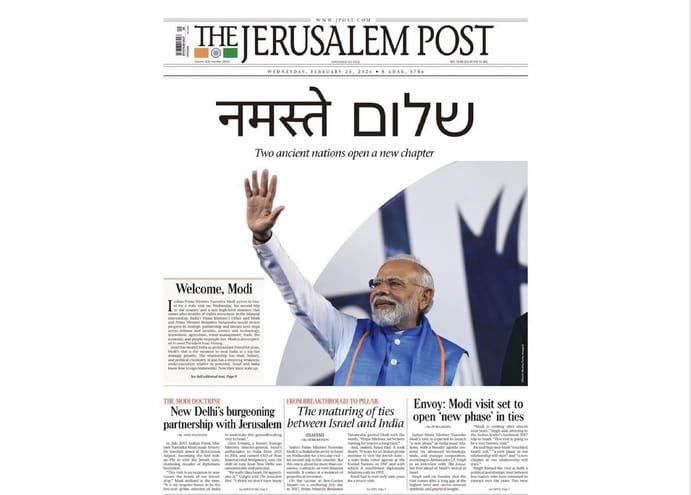
There is no ambiguity in India’s position on terrorism. Terrorism, in all its forms and manifestations, is unequivocally condemned. There can be no justification, qualification, or distinction between “good” and “bad” terrorism. India maintains a policy of zero tolerance toward terrorism and proxy terrorism wherever it occurs. In this context, the 26/11 attacks in Mumbai and the October 7 attacks in Israel are understood within the same moral and legal framework: terror is terror, irrespective of geography or political narrative.
At the same time, India consistently supports initiatives that advance regional stability and sustainable peace. It welcomed the Abraham Accords as a constructive development in a historically volatile region. Despite subsequent escalations, India underscores the importance of preserving avenues for dialogue. It supports the Gaza peace initiative endorsed by the United Nations Security Council, recognizing its potential to foster security and dignity for all communities in the region, including Palestinians. While acknowledging the complexities inherent in conflict resolution, India affirms that dialogue remains indispensable to any durable settlement and joins Israel in advocating stability and engagement.
India expresses deep appreciation for Israel’s knowledge based economy and technological leadership. Historical and civilizational linkages between the two societies are longstanding. References in the Book of Esther and Jewish traditions, including the Talmud, allude to ancient connections. Jewish communities have resided in India for centuries without systemic discrimination, contributing significantly to commerce, culture, and public life. Today, vibrant Indian Jewish communities in Israel continue to make meaningful contributions across sectors such as research, healthcare, education, and defence.
Shared history further strengthens bilateral ties. During the First World War, Indian soldiers played a pivotal role in the Battle of Haifa, a chapter commemorated with honor in both nations. During the Second World War, the Jam Saheb of Gujarat extended refuge to Polish and Jewish children, exemplifying India’s civilizational ethos of humanitarian protection and pluralism.
India recognizes Israel’s remarkable achievements in agricultural innovation, particularly in arid and semi-arid environments, including advancements such as drip irrigation. The strategic partnership between the two countries has expanded substantially in scale and scope, with a shared commitment to deepening cooperation across priority sectors.
As one of the fastest growing major economies globally, India is on course to emerge among the world’s three largest economies. Israel, widely regarded as the “Start up Nation,” stands as a global leader in innovation and entrepreneurship. Together, both countries seek to expand trade, promote joint infrastructure development, and unlock the full potential of their bilateral relationship. Although trade volumes have grown considerably, they remain below the level commensurate with their economic complementarities.
India’s broader strategic outlook is reflected in its engagement in major trade frameworks and connectivity initiatives, including the India – Middle East- Europe Corridor and the I2U2 grouping. Bilateral cooperation with Israel encompasses defence, technology, and innovation, underpinned by multiple Memorandums of Understanding.
In 2018, India and Israel inaugurated a joint innovation laboratory in India, symbolizing a forward-looking technological partnership. Cooperation is intensifying in emerging domains such as quantum technologies, semiconductors, artificial intelligence, and digital public infrastructure, including cross-border financial systems. Multilateral platforms, such as India’s AI Impact Summit, underscore shared aspirations for global technological leadership.
Collaboration in agriculture and water management remains a cornerstone of the partnership. Israel’s expertise has facilitated the establishment of 43 centers of Excellence across India, with plans for expansion. These initiatives advance sustainable farming practices, desert agriculture, and water conservation, thereby strengthening food security and rural resilience.
Cultural and people to people ties complement strategic cooperation. The growing presence of yoga centers in Israel reflects expanding cultural exchange. Parliamentary engagement mechanisms, such as the Indian Parliamentary Friendship Group for Israel, foster sustained dialogue between legislative bodies. Indian skilled professionals in Israel have demonstrated notable commitment and service, even during periods of heightened uncertainty.
Ultimately, the India-Israel partnership rests on shared historical experiences, convergent strategic interests, and civilizational affinities. The Indian philosophical principle of ‘Vasudhaiva Kutumbakam “the world is one family” resonates with enduring ethical traditions within Hebrew thought. Both Judaism and Hinduism emphasize moral responsibility expressed through conduct and action. Cultural parallels such as the illumination of Hanukkah candles and the lighting of diyas during Diwali, or the celebratory spirit of Purim and Holi symbolize deeper bonds of heritage and shared human values.
This bilateral relationship is thus multidimensional and mutually reinforcing, grounded in history, strengthened by strategic alignment, and oriented toward stability, innovation, and global cooperation.