


In international relations, bandwagoning does not mean chasing fashionable trends. It refers to a strategic choice by weaker or middle powers to align with a stronger, often threatening, power rather than resist it. States do this to gain security, avoid conflict or share in economic or strategic benefits when opposition appears too costly or futile. Recent shifts in Western diplomacy suggest a quiet return of this logic.
The Canadian, Prime Minister Mark Carney has framed a new direction with the declaration, “This is our country, and we decide what happens next.” The message signals strategic autonomy and a partial distancing from the United States. Critics accuse Carney of selling out Canadian sovereignty to globalists, yet his approach appears more pragmatic than ideological. China is Canada’s second largest trading partner and the world’s second largest economy. Carney has argued that a stable and constructive Canada and China relations could enhance prosperity and security on both sides of the Pacific. This marks a significant shift. For nearly a decade, Canada China relations have been distant and uncertain. Carney’s government is now reopening dialogue through strategic partnerships in clean energy, agriculture, and finance. This is notable given that Carney warned Canadians about China during the election campaign, yet his government is now engaging even with China’s state media apparatus. What appears as contradiction instead reflects strategic necessity rather than naïveté.
France has been even more explicit, President Emmanuel Macron has openly welcomed Chinese investment, stating, “China is welcome. What we need is more Chinese direct investment in Europe.” Macron has called for increased Chinese capital and technology transfers, framing Europe as a space that prefers respect to bullying and the rule of law to brutality. France’s message is clear. China is not only tolerated but actively courted as an economic partner.
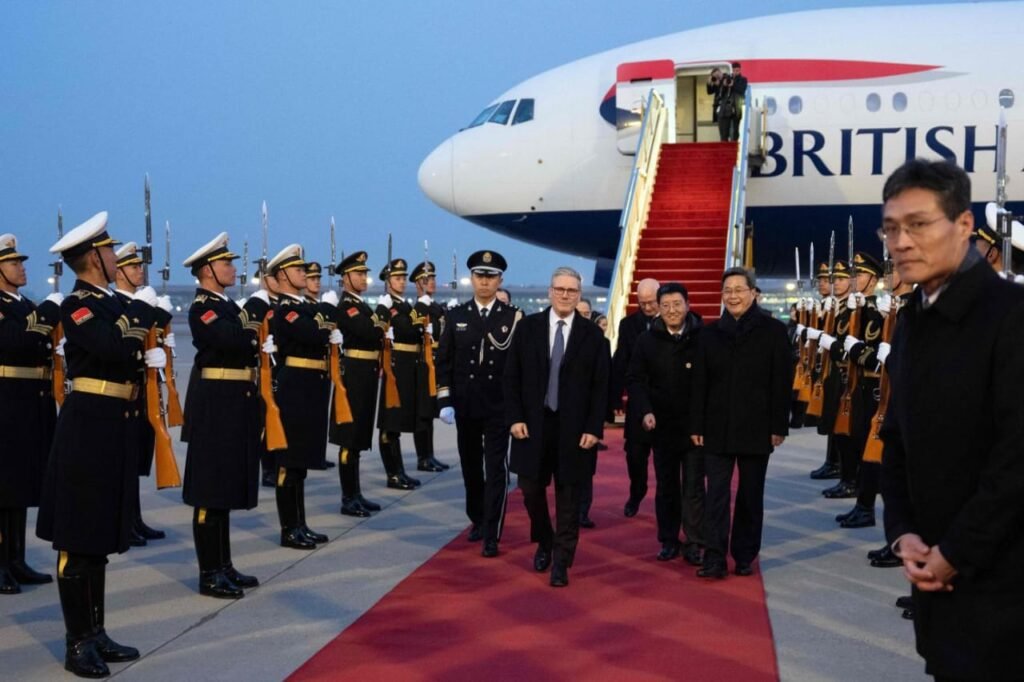
The United Kingdom follows a similar path. Upon landing in Beijing, Prime Minister Keir Starmer stated plainly, “It is in our national interest to engage with China.” His visit, following Canada’s and making him the second NATO leader to travel to China in the same month, aims to deepen trade and economic ties. Starmer has spoken of the need for a long term, consistent, and comprehensive strategic partnership with Beijing. Critics label this as desperation driven appeasement. Supporters see it as economic realism.
One interpretation is that these moves are strategic signalling towards the United States, particularly towards Trump administration. Donald Trump’s reluctance to confront Russia as aggressively as expected may have encouraged European liberals to hedge by engaging America’s primary rival. But a deeper analysis suggests this goes beyond signalling. These are not symbolic gestures. They involve, diversified trade agreements and deliberate efforts to reduce dependence on United States led security and economic structures. European states are increasingly positioning themselves to avoid being dragged into a future conflicts.
Israel’s Prime Minister Benjamin Netanyahu has expressed a desire to reduce Israel’s reliance on United States military aid, a remarkable statement from Washington’s closest Middle Eastern ally. The United States today is overstretched, from the Atlantic, through the Mediterranean and Indian Ocean, to the Pacific. Decades of military commitments, compounded by domestic pressures including rising healthcare costs, demographic strain, expanding debt to GDP ratios, and economic exhaustion outside highly evolved innovation and technology sectors have fuelled voter demand for retrenchment and withdrawal from global institutions which are funded by American taxes. For decades, European social democracy benefited from an international system underwritten by American capitalism and security guarantees. As that system reaches a tipping point, the European is seeking strategic refuge through diversification rather than idealism and loyalty. To American and European right wing movements, this appears as betrayal. To European Union leadership, it is survival. This shift is not an indictment of the United States, but a reflection of how all great powers, including America, recalibrate when domestic and global constraints converge. While political rhetoric in Europe emphasizes values, European leaders continue to land in Beijing, Moscow’s closest strategic partner.