

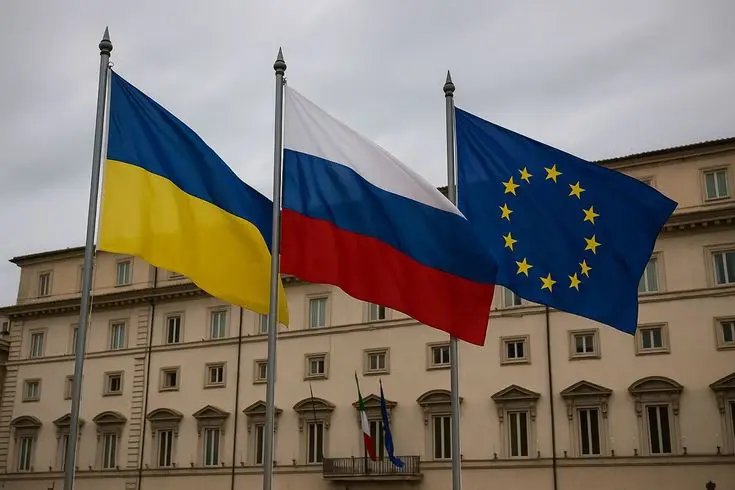
The Russia-Ukraine conflict is marred by history, economics, and the national interests of several European members. If we look through the prism of geography, the geolocation of Russia greatly shapes the strategic military culture of the Kremlin. The Northern European plain stretching from the west of the Urals to France, with a relatively direct flatland corridor through Poland straight to Moscow has historically been perceived as a vulnerable terrain. However, both Napoleon in 1812 and Hitler in 1941 are instances where Russia’s strategic depth functioned as a safeguard for her sovereignty by mitigating external military threats.
Fast forward to the post-Soviet Union collapse in 1991, a NATO membership for Ukraine is perceived as a national security threat within the Russian administrative circle.
Ukraine tilted west instead of staying a buffer, which Moscow claims compelled it to advance into Ukraine to “demilitarise and denazify” the country. The conflict began with Russian advances into Crimea in 2014 and proceeded with Moscow’s involvement in Donetsk and Luhansk, escalating into a full-scale war in 2022. Russia gained territory and strategic leverage, including firm control over the deep warm-water port of Sevastopol.
At the same time, Ukraine’s westward orientation cannot be explained solely through the prism of great power rivalry or buffer-state logic. Domestic political transformations, particularly the 2013-14 Euromaidan movement, reflected a sustained societal push within Ukraine toward European integration, institutional reforms and political sovereignty distinct from Moscow’s influence. Public opinion shifts, generational change, and Ukraine’s post-Soviet nation-building trajectory increasingly aspired Kyiv to pursue Euro-Atlantic norms and institutions, even as such alignment heightened its exposure to conflict. Ukraine thus emerges not merely as a passive arena of contestation but as an active political actor asserting agency within a constrained and asymmetric international system.
After World War II from 1939 to 1945, a shattered Europe alongside a powerful United States and the emergence of a liberal institutional order in International Relations compelled European states, including France and Germany to align with the United States for security guarantees through NATO. While the European Union constitutes a measurable economic success reflected in the creation of a single market, high levels of intra-EU trade and the eurozone, its security architecture remains constrained by limited collective military capabilities and continued dependence on U.S. power. Fragmentation in defence planning, uneven military spending, and divergent threat perceptions underscore these challenges. A united Europe capable of coordinated economic and security action therefore remains a structural requirement. The pursuit of European strategic autonomy unfolds as a multidomain policies for self-reliance in Defence and Security sector, Energy sector as green energy investments which reduces dependence on Russian gas, EU chip Fabs for technological sovereignty and the German rearmament project, alongside nuanced financial and trade policies, these changes must account for fiscal constraints and institutional cohesion to ensure it does not fragment the eurozone but strengthens it.
The series of events to date have elevated Russia Ukraine conflict as a case study in military strategic discourse and exposed European security vulnerabilities, while the most persistent strain remains on Ukrainian sovereignty. Any lasting conflict resolution requires multiple stakeholders addressing security concerns, principles of sovereignty and international law.