



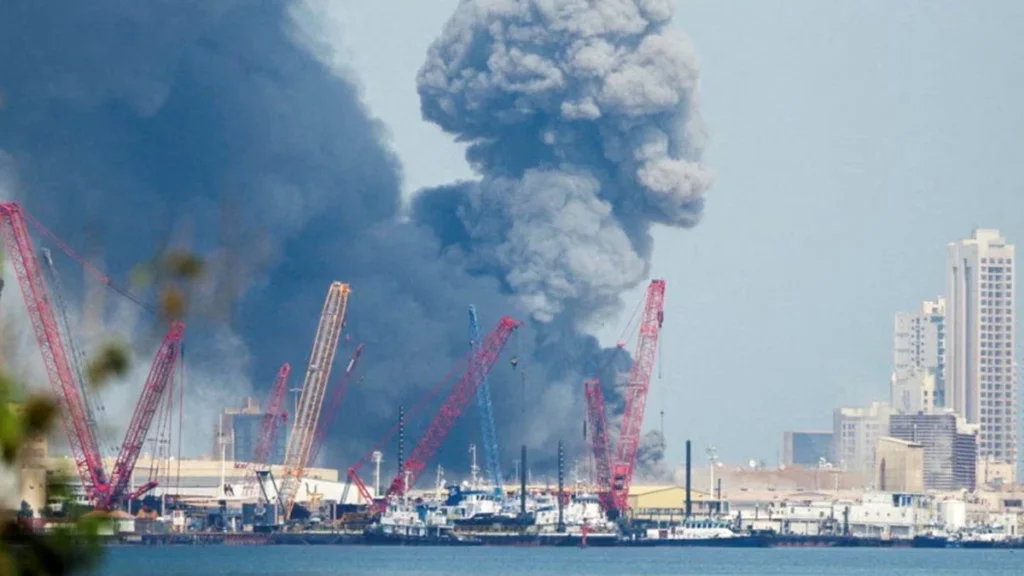
Not a long time ago, the United States’ Operation Absolute resolve did something unthinkable, it moved into a sovereign nation and abducted their leader from his own home. Venezuela has since become a subject to Washington instead of a separate country. In every way save for flying the American colours. Though destitute, Caracas was not at the helm of an incompetent army, yet, US managed the operation with relative ease, as far as operational realities go.
Tehran has had it much worse. As soon as the Islamic regime established itself, Saddam Hussein tried to leverage the opportunity and with the blessings of Washington too. The nearly decade long war of attrition that followed was by no means a good start for anyone aiming to rule the piece of land that is Iran. Followed by sanctions, the massive oil reserves of the nation have been largely helpless in improving the situation.
But being cut off and betrayed might be a death sentence for anyone else, Tehran has managed to build something out of the ashes. It is not some backwater sand filled barren land with Bedouins and tents, its an ancient, vibrant and proud nation with a rich and recent history of progress and almost every strategic asset that a nation can have in order to be a regional heavy weight. That, despite Washington’s best efforts, makes it lucrative. Being lucrative, itself is an asset. It allows you to get people to invest.
While the long and painful history of Iran is best left for another day, this is a dummy’s guide to the military realities of the region because politics, international law, ideology, they all went out the window a long time ago and the will and ability to spill blood is not the only thing standing in the way of who controls the fate of Iranians. It is a duel of the devils, no matter how you slice it.
Out of the bat, the most important asset in modern warfare is control over airspace. If you control the air over a region, you are already closer to winning the war. Of course, real change needs boots on the ground, but birds in the air make sure that those boots are not empty and in a pine box on a flight back home. The reason is simple, it is hard to defend against something above you and in front of you, at the same time, moreover, the sky does not limit where your enemies come from and you can’t set up ambushes or pickets. In that Regard, the US Navy far outclasses the IRIAF. The latter left with vintage F-14s in questionable numbers and flight worthiness, F-4s of the same era and condition, F-5s and Mig-29s. Anyone familiar with military aviation knows this is the sort of situation where you wouldn’t even want to say it’s the pilot that matters. For those less through, let’s just say IRIAF’s best defence is that an American pilot just gets emotional about shooting down legacy aircraft and leaves.
So what? Air defence systems are as close as you can get to pickets in the air, and IRGC has an impressive collection thereof, including Russian S300s although, of questionable heritage since they were sourced from third parties and not Russia directly, which had blocked their exports. Not the bleeding edge of air defence and one might be compelled to think, if the Israeli and US systems are failing and conducting friendly fires as we have recently seen, what hopes do older and untested systems have? The question is fair, but not nearly the most pertinent. For one thing, Iran has the advantage of not having any assets in the air, so friendly fire is a no factor to them. For another, planes are not nearly as fast as ballistic missiles are nor are they as cheap as expendable kamikaze drones. So, saturation attacks don’t work. So while the aggressors can not saturate the airspace with numbers and disregard losses, Iran can shoot anything and everything that it sees, till it’s heart’s content or till they run out of ammo.
Okay, so why, with such advantages, are top government and military officials dead in Iran then? If anything, Iran also has strategic depth and harsh terrains with high peaks which should make early warning and protection easy. Therein lies the real question.
To understand that, we need to understand a core principle of any warfare, “defence is never perfect”. You can have the strongest bunkers, the best gun positions, near clairvoyant early warning and the most brutal ambush, the mere fact that it exists, means it has finite capabilities, and so it can be one-upped. In simple words, if it can be defined, it can be countered. So, what counts after a point is, how motivated you are to defend, how capable your machine is, and how much you can take.
Problem with that is, the more bases you want to cover, the complex your solution becomes and the larger the price tag. Even well to do nations create layered defences with redundancies instead of impenetrable walls, it’s a mesh of interconnected systems that take care of what the other misses. Et voila! The existence of network centric warfare. Something that requires advanced technology, extensive, contemporary experience and a robust industry. None of which Iran has in 2026. To make things worse, the massive geography itself becomes a liability, it creates strategic depth against an evenly matched enemy, but let’s say 400 miles detour against a defensive stronghold to a mechanised infantry unit might be weeks or months, to infantry, might be unfeasible but to a supersonic jet, is just an inconvenience.
To make things worse, Iran is surrounded by US military bases on all sides and a single carrier battle group of the USN can take on missions over the entire country if need be. This means, it has to dilute its defences to all directions, and even if their AD systems, most of which are homegrown, are in fact as good as they claim to be on paper, they still fall short of the electronic capability of the forces they face and are not nearly in great enough numbers to make a difference anyway.
As an Indian, one may ask, India has a big geography, and we managed fairly well in Op Sindoor, and Israel with their hyped Iron dome and David’s sling and the US Patriots and THAAD still could not handle it, what did we do different? The answer is again, in operational realities. It is not about the machine but the environment and interface between allied units and operators alike. You cannot shoot a million-dollar missile for a thousand-dollar drone. It’s economics and few things invoke economics like wars do. With India, our aggressor was only along certain sectors and from one direction. On that regard, we are in the same boat. The difference is, our radars can cover the entirety of Pakistan, so anything that get higher than an electric pole off the ground, is being painted by us. Iran hides in the Earth’s curvature, nothing short of a satellite of assets in the air over the launch site can tell you something has been launched. This also means, IRGC can shoot from any point out of the 1.2 million square km of their nation, and no realistic way for anyone to cover it all in real time, so by the time a missile is visible in the radar horizon, i.e. the line of sight of the radar’s beam, it is already half way to the target. At hypersonic speeds, that is simply too late.
Another factor is India itself has strategic depth and target scarcity, so even in the face of unethical war practices of engaging civilians, the enemy still has to be discriminating enough to make it count. For Israel and its little over 22 thousand square km existence, you can’t throw a rock without it hitting something of importance. It is what is called a “target rich environment” for a player like the IRGC which has a proven and self-acknowledged history of both human rights violations as well as antisemitism to the point of genocidal fantasies. More than that since they have acted on said fantasies through proxies in brutal ways over the decades. So, while India can count on a stray bogey to be left untouched, or even choose to defend civilians over military targets, Israel does not hold that luxury.
What about the rest of the Gulf countries? They have great systems, but not the experience or the integration to use them well. As is evident from the friendly fire. One or two is understandable, three? While it maybe due to a plethora of factors, given the broader sense of things, it is likely that the operators are panicked and not used to handling such rampant threats to their safety, not through any fault of their own, but simply because they are used to being under fire.
Relying on systems alone is archaic, gone are the days when missile and AA batteries would defend a position and wouldn’t need to care about what happens next door. Anti-Air is now at the forefront of combat more than ever, and a mediocre system with great integration makes it a formidable defence while a great system poorly deployed ends in loss of the system as well as whatever it defends, Case in point, India used L-70 guns and Soviet Pechora missiles to near perfection against state of the art weapons while Russians have lost S400 batteries to old and often low cost Ukrainian implements.
Iran understands this leverage and given their experience through decades of proxy wars against advanced states, it is safe to assume they know how to even the odds. They invested in attacking capabilities, going so far as to create cluster munitions on ballistic missiles. On that regard, it is probably best that they don’t get a nuke, but taking down of their leadership means this has gone from existential to “a last stand” for them. Their ballistic and drone capability may not survive the invading technology long enough to keep attacking the Gulf and Israel, but to truly dismantle it, there needs to be boots on the ground, but combining the motivation and experience with asymmetric warfare that IRGC has and the decent amounts of modern if obsolescent hardware that they have, the likelihood of this becoming another protracted of attrition with no clear end in sight is just on a meteoric rise. Should that eventuality come, whether through internal dissent in USA or through designs of Langley and Pentagon, Iran might very well devolve into the next Iraq or Libya and IRGC might become a second coming of the Islamic State.
For India, this is a chance to dismantle ideological networks within its borders to prevent a potential surge in radical Islamic activities, in the event that the IRGC does become a rogue fundamentalist element.