


India, with a nominal GDP of approximately USD 4.5 trillion and an IMF-projected growth rate of around 7.3 percent in FY2026, remains among the fastest-growing major economies globally. Over the past decade, structural reforms, sustained infrastructure expansion, and the growth of public-private partnerships particularly in startups in Defence MSME, Space Tech and manufacturing have enhanced India’s economic resilience and global competitiveness. India holds a strong comparative advantage in human capital, communication intensive services, and exports in IT, software, and digital services. These strengths are highly complementary to the European Union’s ecosystem of innovation, advanced manufacturing, research intensity, and leadership in science, technology, engineering, and mathematics.
The European Union, comprising twenty seven member states, accounts for roughly 14.7 percent of global GDP and represents one of the world’s most influential integrated markets. While not all EU members are part of the G7, the bloc exercises substantial economic, regulatory, and technological power, frequently setting global standards across trade, sustainability, and digital governance.
India’s pursuit of free trade agreements reflects a broader diversification strategy in an era marked by tariff barriers, supply-chain weaponization, and economic coercion. Trade diversification increasingly functions as an economic deterrent, reinforcing resilience.
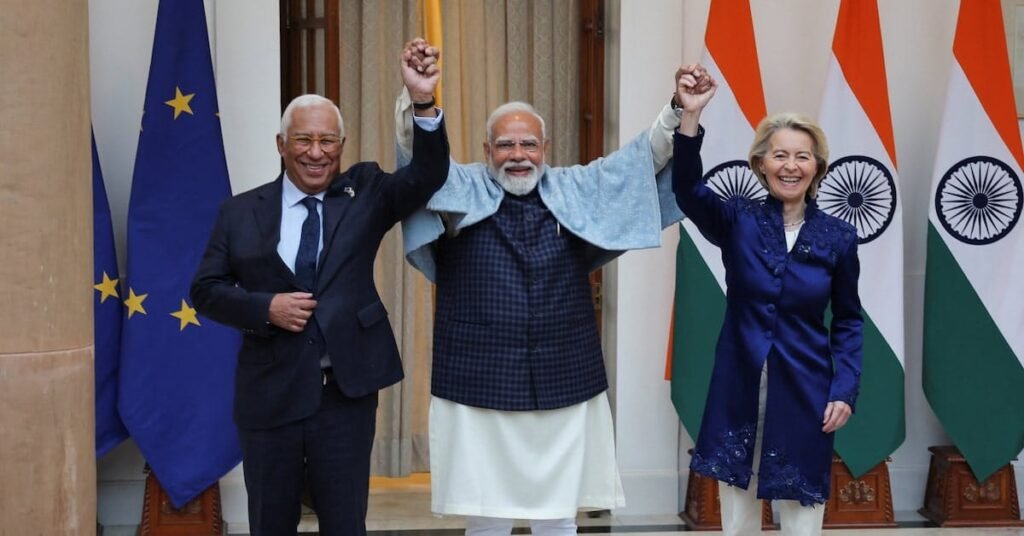
An India-EU trade agreement would allow Europe to become a direct stakeholder in India’s growth trajectory, while India’s “Make in India” programme aligns with Europe’s need for diversified, resilient, and trusted supply chains. As India is trying to make measurable progress in secondary manufacturing, the next phase of growth requires access to large, predictable export markets an area where the EU is uniquely positioned.
India has already concluded trade agreements with partners such as the UAE, Australia, and the United Kingdom. However, an agreement with the EU stands apart in both scale and depth, offering access to twenty seven national markets under a single regulatory framework. This would significantly expand opportunities for Indian exports in manufacturing, pharmaceuticals, engineering goods, and services, while incentivizing quality upgrades and cost efficiencies. Existing bilateral ties with individual European countries would be consolidated and amplified under a unified framework.
From the European perspective, the agreement is equally strategic. Amid rising protectionism, geopolitical volatility, and supply-chain concentration, Europe is increasingly cautious about excessive dependence on either the United States or China. India offers a credible alternative, combining economic scale, sustained growth, democratic stability, and growing policy convergence with Europe.
Beyond economics, evolving security challenges and internal pressures within NATO have placed Europe in a more complex strategic environment. In this context, deeper engagement with India one of the world’s largest military powers provides Europe with added geopolitical leverage. India’s defence ecosystem is uniquely diversified, encompassing Israeli technologies, French combat aircrafts, Russian strategic systems, U.S. defence platforms and a rapidly innovative Indian indigenous research and manufacturing base. This interoperability and breadth enhance India’s attractiveness for defence industrial cooperation, joint ventures and co-production arrangements. India also brings extensive operational experience in managing simultaneous security challenges, including border tensions, internal insurgencies and asymmetric threats across diverse geographical and socio-political environments. This experience strengthens India’s strategic value for Europe as European policymakers increasingly focus on rearmament, defence readiness, and strategic autonomy.
Closer alignment with India enhances Europe’s strategic options not through formal military alliances, but via defence industrial cooperation, intelligence sharing, and shared security assessments.
The European Union’s emphasis on AI governance, data protection, and digital regulation aligns closely with India’s vision of strategic self-reliance. Both sides seek to reduce technological dependence on external powers while preserving open, rules-based digital ecosystems. This convergence in digital sovereignty, data governance, and technology policy represents a critical pillar of the India-EU partnership, particularly as both sides navigate competition in emerging technologies and platform-based economies.
India and the European Union are anchored in shared climate and sustainability objectives. India is a signatory to the Paris Agreement and a founding member of the International Solar Alliance, with renewable energy forming a core pillar of its development strategy. Both partners seek long-term energy security and reduced dependence on fossil fuels and external energy shocks. India’s strengths in large-scale manufacturing, cost-effective deployment, and rapidly expanding domestic markets complement Europe’s leadership in research and development, advanced green technologies, and regulatory standards. This complementarity creates strong potential for collaboration across solar and wind energy, green hydrogen, energy storage, and grid modernization, while supporting supply-chain diversification and climate commitments on both sides.