



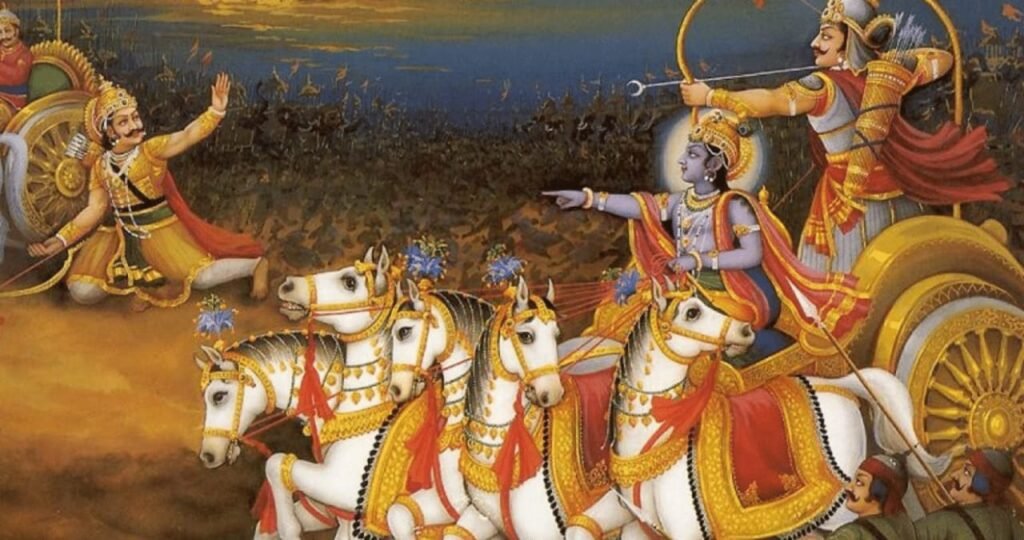
Long-long ago there was a great war among kins for prestige, power, and possessions. This tale arises from the ancient land of India and is revered as ‘Itihas’, (history preserved as sacred memory and eternal truth).
The Mahabharat not only guides the soul toward spirituality, most profoundly on the sacred battlefield of Kurukshetra through the ‘Bhagavad Gita’ spoken by Bhagavan Shri Krishna to the great warrior Arjun, calling upon him to abandon hesitation and attachment to misguided cousins and kin and to take up arms for the sake of history and the destiny of the future, in defence of a righteous cause. It teaches the rising above karma through detachment from personal emotion, and perform ‘nishkama karma’, where action is performed without bondage to its fruits, in service of the greater good of society and the unfolding of time itself.
This epic is not merely holy, but also a majestic treatise on statecraft, where the Supreme Statesman Shri Krishna leads Bharatavarsha through the labyrinth of dilemmas and the seductive illusions of idealism, shaping the moral course of history centuries before the ‘Arthashastra’ of Acharya Chanakya, who confronted the brutal tyranny of the Nanda dynasty in the empire of Magadha and with his disciple Chandragupta Maurya, overthrew it to establish dharma, the righteous rule of law and order, and to end matsya nyaya, the age of anarchy under King Dhana Nanda whose conscience was eclipsed.
However, the contemporary world is no less than a repetition of the Mahabharat. The dice of destiny had already been rolled when India was ahead of China in the 1950s in terms of economic growth, yet it gradually fell behind due to a convergence of factors, these included policy inertia, adverse global circumstances, and a prolonged vacuum in political leadership marked by limited assertive decisiveness in governance and foreign policy. From being categorized among the “Fragile Five” economies in Morgan Stanley’s 2013 report, India has since altered its course, with recent International Monetary Fund in 2026 assessments recognizing it as one of the key engines of global economic growth. India once again stands on a Kurukshetra where rival powers contend for global supremacy, echoing the conflict between the Kauravs and the Pandavs. In this era, India invokes the wisdom of Shri Krishna by practicing the diplomacy of strategic autonomy, just as during the Mahabharat the shadow of war stretched across the land, Kauravs and Pandavs arrived at the resplendent city of Dwarka, seeking the counsel of Shri Krishna. The Lord lay in calm repose, Duryodhana claimed the seat of honour by his head, while Arjuna stood in humble silence at his feet. After awakening, Shri Krishna offered a choice, between the might of His Narayani Sena, or Krishna Himself, unarmed and vowed not to wield the bow. Duryodhan seized the army and Arjun chose the Lord alone.
Just as both sides in the epic sought Krishna’s presence, today competing powers seek to draw India into their alliances for their interests. The vast and diverse Indian diaspora resembles the Narayani Sena, influential yet distributed across the world often contributing to the economies of the developed world, while India itself chooses the role of the charioteer rather than the warrior. In a fractured global order, India balances major powers with a greater responsibility towards humanity, aware that complete alignment with any one major world power would compromise her sovereignty. This approach reflects the essence of Shri Krishna, the eighth avatar of Lord Vishnu, whose purpose was not blind partisanship but the preservation of balance between opposing forces, protecting the world from destructive extremes.
India seeks to maintain a strategic partnership with the United States, strengthen bilateral relations with European nations, expand strategic partnerships in Central Asia and the Middle East and Global South, maintains non-reciprocal relations in its neighbourhood, and is preparing to lead BRICS in 2026 on the themes of sustainability, cooperation, resilience, and innovation. In the theatre of today’s world, the United Nations stands as Dhritarashtra, the blind king who forgets the sacred weight of his duty, hesitating where action is demanded. In that silence, the fragile threads of peace unravel, leaving nations vulnerable to the ruthless currents of power, and allowing Machiavellian realpolitik to shape the destinies of millions with cold, unfeeling precision. History always repeats itself. For the civilization of India, it echoed through the centuries. From the 12th century, at the Battle of Panipat, Maharaj Prithviraj fell to the armies of Ghori, invading from the Khyber pass, in 1857, the War of Independence rose and faltered. In the fires of World War One and World War Two, India’s voice for independence from the colonialism of the British Raj was silenced and, in the partition of 1947, the land wept, torn and divided. Every time, idealism, passivity and lack of proactive actions betrayed her. Every time, her share of power on the global stage slipped away. Her civilizational grandeur burned to ash, and her people were robbed of dignity and prosperity.
India endured. India remembers. Yet the weight of history is heavy, and the sorrow of what could have been lingers like a wound across time.
As Goethe stated ‘A nation that doesn’t honour her past has no future’ as a result foreign policy is never static, it is a living, dynamic art, forged in the fires of geography, culture, history, economy, and the imperatives of strategic partnerships, It is shaped by the norms of the global stage and by the relentless currents of power that sweep across nations. To navigate this shifting world, wisdom is not merely desirable it is indispensable. As Thiruvalluvar teaches, one must move in harmony with the tides of change, aligning action with both circumstance and principle.
India’s path is therefore deliberate, yet unwavering, guided by lessons hard earned, tempered by vigilance, the purpose is resolute, balancing the moral weight of duty with the strategic demands of the world.
Here, in this crucible of history and ambition, the call is unmistakable, to act with courage, to think with clarity, and to rise in step with the evolving world so that every decision echoes not only across the corridors of diplomacy but in the enduring welfare of the citizens.
India steers her destiny with dignity, prudence, and an unwavering commitment to the generations yet to come. Therefore, in a world of many players on the diplomatic battlefield, nations striving for hegemony, Indian foreign policy stands as her own charioteer and this time there is no Arjun, but her own people and their national interests.