



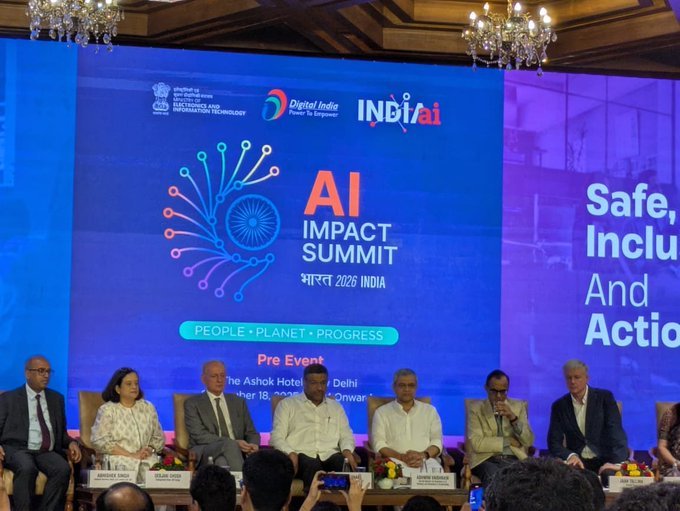
As India hosted AI Summit (fourth version of its global series) at Bharat Mandapam in New Delhi from 16th to 21st Feb 2026 by MEITy( Ministry of Electronics and Information Technology) under Shri Ashwini Vaishnaw , it was unique as earlier this type of summit used to be hosted in cities of Western Hemisphere, but this time it portrayed India as a center of attraction and positioning itself as in charge of Global South through inclusiveness of spaces, representation and Democratization of AI providing assistant and expertise to these nations opening up new avenues of cooperation and co-development of AI infrastructure, acting as a bridge between developed nations and aspiring nations. It was inaugurated by Hon’ble Indian Prime Minister Shri Narendra Modi along with joint address by French President Emmanuel Macron and UN Chief Antonio Gueterres. It witnessed participation from several Heads of State and Government, including UAE Crown Prince Sheikh Mohammed Bin Zayed, Brazilian President Lula da Silva, and 20 other leaders, alongside 45 international delegations. Tech luminaries such as Sundar Pichai (CEO, Google), Sam Altman (CEO, Open-AI), Jensen Huang (CEO, NVIDIA), Demis Hassabis (CEO, DeepMind), and 40 other CEOs of leading AI and technology companies were in attendance. In total, the summit recorded over 35,000 registrations from more than 100 countries, marking it as a truly global gathering. Due to its high in demand and overwhelming response it was extended beyond its planned dates recording first in the timeline of global summit history. Through this India introduced a unique framework for AI development centered around three pillars of “People”, ”Planet” & “Progress” :-
- People:- focus on human-centric approach of AI that empowers the communities with and emphasis on inclusive access of AI tools to them. It highlighted its sphere of coverage on health, education, social upliftment, investment in human capital and skill development ensuring benefits to everyone.
- Planet:– addressing issues through sustainable, energy efficiency and climate resilience for planetary welfare, showcased applications for sectors- smart AI tools for agriculture, proper waste management, renewable energy etc keeping the needs of future generations as primary consideration.
- Progress:- centralizing on innovation, greater collaboration, learning and sharing with global leadership. Promoting India’s startup ecosystem to develop indigenous AI solutions for the problems to strengthen India’s AI sovereignty through detailed policy framework and expert-consultation.
and seven Chakras for Theme of Global Cooperation which were:-
- Human Capital:- finding optimal solutions to align individuals irrespective of their geography, gender and socio-economic strata to ensure their participation proactively by knowledge sharing with capacity building through upskilling and international cooperation transitioning into a sustainable and highly skilled workforce.
- AI for Socio-Economic development:- channelling potential through optimal approaches by facilitating cooperation, best practices and knowledge sharing with innovation making a large and socio-economic impact visible.
- Inclusion of Social Empowerment:- gathering and connecting people all across the globe and mining their potential that can deliver benefits to all and uplift of some special communities by breaking down hurdles in the pathway.
- Resilience, Innovation and EWG:– developing local AI systems that are sustainable, resilient, resource efficient with greater accessibility through greater commitments and active partnerships with proper roadmap and advancement.
- Science WG:- enshrine and expediting the discovery by use of AI through open, non-opaque, transparent, equitable scientific engagement narrowing up the divide keeping the shared principles with mutual and collective understanding.
- Democratising AI resources:– delivering equitable and affordable for all, ensuring voices, representation and meaningful participation of every nation in benefits and program building by fostering cooperation among them.
- Safe & Trusted AI:– providing reliability of AI systems, security, privacy that people can put up their faith by promotion of locally developed safety tools, best optimal practices in sectors across the globe and also investing in futuristic AI safety mechanism.
Furthermore, as per Minister of IT Shri Ashwini Vaishnaw, more than $250 billion of investments and support committed for development of data centers, semiconductor manufacturing as well as designing chips for high power computation indigenously to end dependency on imports, supporting India’s plan for expansion of sovereign cloud infrastructure, creation of new AI startups to support small, medium and large-scale enterprises, govts and existing startups for better function. It started with India AI Impact Expo featuring 300 exhibitions from 30 nations including 10 thematic pavilions.
India’s Quest to build its own Sovereign AI:-
In March 2024, Govt. of India announced the vision of India’s own AI Mission with and approval of Rs. 10,400 crore for the creation of AI startups, infrastructure, and its empowerment in next 5 years (2024-2029) and to develop cutting edge AI computing infra with 10,000 advanced GPUs through PPP(Public-Private Partnership) model. IAIC(India-AI Innovation Centre) also given responsibility to be leading academic institution for searching and retention of indigenous talent as engineers from India and their potential in this domain could be leveraged successfully with an emphasis to develop LLMs (Large Language Models) domestically. In AI Summit of 2026, India displayed indigenously built AI-models:-
- Sarvam-AI:- backed by a private lab, the Company presented its two LLM models Sarvam30B- a 30 billion parameter model and Sarvam105B- a 105 billion parameter model which both were trained on 22 Indian languages for all academic disciplines with 89% accuracy outperforming and positioning it way ahead compared to other global models.
- Bharat-Gen:- India’s first govt. backed model to develop multilingual AI models for its one to one speech, text to speech generation, ASR etc with 17 billion parameters, led by group of IITs under the banner of IIT Bombay supporting 22 Indian languages and an answer to Google’s Gemini and Microsoft Open-AI making it viable and best alternative option for large and greater public engagement.
The most important milestone that India announced that it has a computational base network of 38,000 GPUs which now became the backbone of India’s sovereign AI ambitions allowing startups, academic researchers, public institutions, and emerging AI companies to access high-performance computing without needing to invest in expensive hardware. At the summit, the govt. announced the immediate expansion of 20,000 GPUs, taking up the capacity tally to 58,000 GPUs and being executed under a PPP(Public-Private Partnership) model leading to strong expansion of India’s cloud infrastructure. It was also informed that for the short term goals, further 50,000 GPUs are being targeted for active development in the upcoming six months with setting a goal of exceeding 1,00,000 GPUs by the end of 2026, it is very much significant in training up of LLMs and running parallel large scale computation and data processing capabilities making it one of most affordable infrastructure in the world.
End-point Analysis:-
For India it has become a part of national and strategic asset addressing the issues and problems of security apparatus. As AI capabilities concentrate in a few nations and corporations, compute infrastructure has become the decisive frontier of power. For the Global South, this imbalance risks deepening dependency and exclusion. India’s approach—scaling infrastructure through public–private partnerships while retaining sovereign access—offers a distinct model of openness anchored in autonomy. By acknowledging current dependencies yet deliberately reducing them through domestic capacity-building, India signals a path of resilience and self-reliance. With proactive policymaking, disciplined execution, and government-backed incentives fuelling a surge of startups, India is not only securing its own future but also positioning itself as the vanguard of the Global South in shaping a more equitable AI order.