


On 26th January, India celebrated its 77th Republic Day, and it comes with a plethora of undercurrents and a tapestry of not-so-subtle messaging. In attendance as chief guests were the Presidents of European Commission and European council, Ursula von der Leyen and Antonio Costa. As is usually the case, they were hardly mere party guests.
Since assuming office, President Donald Trump has done virtually everything in his power to upheave the world order as it stands. China has been engaging in morally grey economic and diplomatic practices for a while now, and striving to invent time travel to counter threats is a fine goal perhaps, but lacking the subtlety of the Chinese, Washington has straight up resorted to neo-colonialism through hard power. Such brash displays of disregard for international law would require a robust system of support in internationally, but Washington managed to alienate them as well, if not through punitive economic warfare, then through direct military threats, especially using national security as an excuse. Perhaps, the White house blew all their marketing budget in making reels instead of coming up with a noble sounding cause.
Speaking of which, since the historic comradery and relationships ring No Bells (Pun intended), for Mr. President, EU is out in the market looking for a strong economic and military partner. One which is democratic, shares higher western values, and isn’t led by mercurial, trigger-happy authoritarians. As it so happens, India is the one nation that seems custom made for the occasion. The fact that India has refused to relinquish land for any foreign military base, owns and operates systems from both sides of the political world and has an economically blessed geography, well, forget about the rumours of Trump’s strings being pulled for Moscow, one might wonder if New Delhi has some stakes in it.
On a serious note, Indian Ocean Region is the jugular of the world trade and Indo-European trade has historically been one of the corner stones of global trade. India is the largest population in the world and produces a remarkable workforce of varying skill levels, something EU sorely needs. In light of this, it was no surprise that an FTA was reached so quickly between the two.
However, what is noteworthy is the parade India put up on 26th January. Trade aside, it is well known that the hegemons of the world do not like to see nations prosper while having a shred of independent policy. India’s navigation of this scenario is a geopolitical case study in and of itself but this article is about the unsung heroes of Indian sovereignty, the Indian Navy.
Historically, naval power has never been about defence as much as it has been about influence. The oceans are not the best domain to wage wars on, however, they are the life’s blood of global trade, and a strong grip on the waters is a critical aspect of any major economy. Indian navy is distinguished in it’s service, from the attack on Karachi to the blockade of East Pakistan and the incredible and often overlooked operations in anti- piracy over the Indian Ocean. Not being in sight and a lot of it being classified, Naval warfare is often overlooked in popular media, and while Kashmir and North East steal the show with their frequency and the Air Force through the sheer “cool” factor of aerial warfare, the Indian Navy with its isolated vessels and highly technical and classified technology aboard slow moving metal giants, does not exactly ooze aura, as the parlance goes.
However, Naval warfare has become more critical to India than ever, while India, in a strategically brilliant move, attempts to project itself as an ethical and strong keeper of the IOR, our threats nearby are not merely pirates. PLAAN of China operates one of the largest and most sophisticated Navies in the world and Indian proximity to Karachi, Gwadar, and Straits of Malacca are unquestionably a thorn in Beijing’s side. Their entire economic access to the world can be compromised by a strong Indian Navy and operation Sindoor proved that the Nukes in Pakistani arsenal, fail to produce any hesitancy in New Delhi’s resolve.
India has proven that it is not only a responsible and fast-growing large economy but also a military power to be reckoned with. In May 2025, following the dastardly Pakistan backed terror attack on civilians in Pahalgam, Kashmir, India mounted a monumental response in an impressive time frame of little over two weeks. The first war between two nuclear armed nations was the result and while the world teetered on the edge of a nuclear war, India showed its capability at wielding both decisive strength and understanding of battle doctrine in an effortless dance of well channelled wrath. Establishing near air supremacy over a battle-hardened nation state in 90 minutes of air operations is unprecedented to say the least, doing it to a nuclear nation was the first time it has been done, and with good reason.
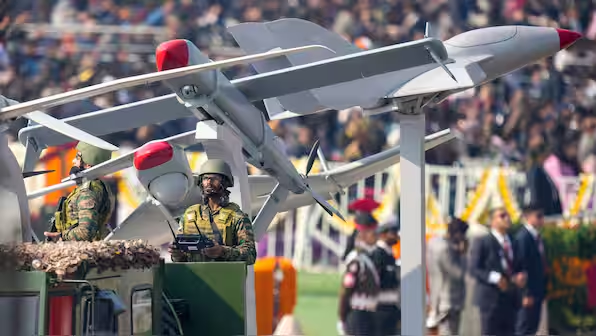
What stands out is the use of indigenous weapons in this war, from drones to missiles to AD systems, artillery and even the AFNET. India displayed a chilling command over its martial capabilities and the echo of that is what we witnessed on 26th January. The theme of Operation Sindoor took centre stage, opening displays included armed troops in combat ready gear, departing from the standard salute to a tactical display without losing trigger control. There was a lot to unpack there, and yet it as just the tip of the ice berg. But the intention was clear, to Signal the EU that India is moving leaps and bounds towards self-reliance and our military might is not to be trifled with. Not a warning, but an invitation.
One of the primary reasons behind EU’s apparent blind faith towards Washington came from USA’s geographic safety and advanced military technology. Europe outsourced a bulk of expensive military R&D to US and used the money to fund welfare schemes domestically. However, recent events have shown it to no longer be a sound strategy. In such an event, India is rising up as an economically capable partner which has the battle experience and record to guide development and enough experience of their own in developing low cost, reliable solutions that they can serve as a valuable partner in Europe’s own defence infrastructure. France had already proven the method to be a viable one, developing multiple systems in collaboration and some major ones on the table in the near future.
Technology aside, in return, we might see India get a better grip on western narrative which has been hitherto ignored or controlled by Chinese and Pakistani nationals using western media apparatus. This is plausible since China is still a hostile entity with a record of weaponizing economy and engaging in grey practices. This is the rise of a new era of military cooperation and while the Indo-European FTA gets all the fanfare, this aspect of the deal is likely to slip past in the shadows. However, the nature of such a pact might collapse a stable route ahead in an otherwise uncertain near-future.