



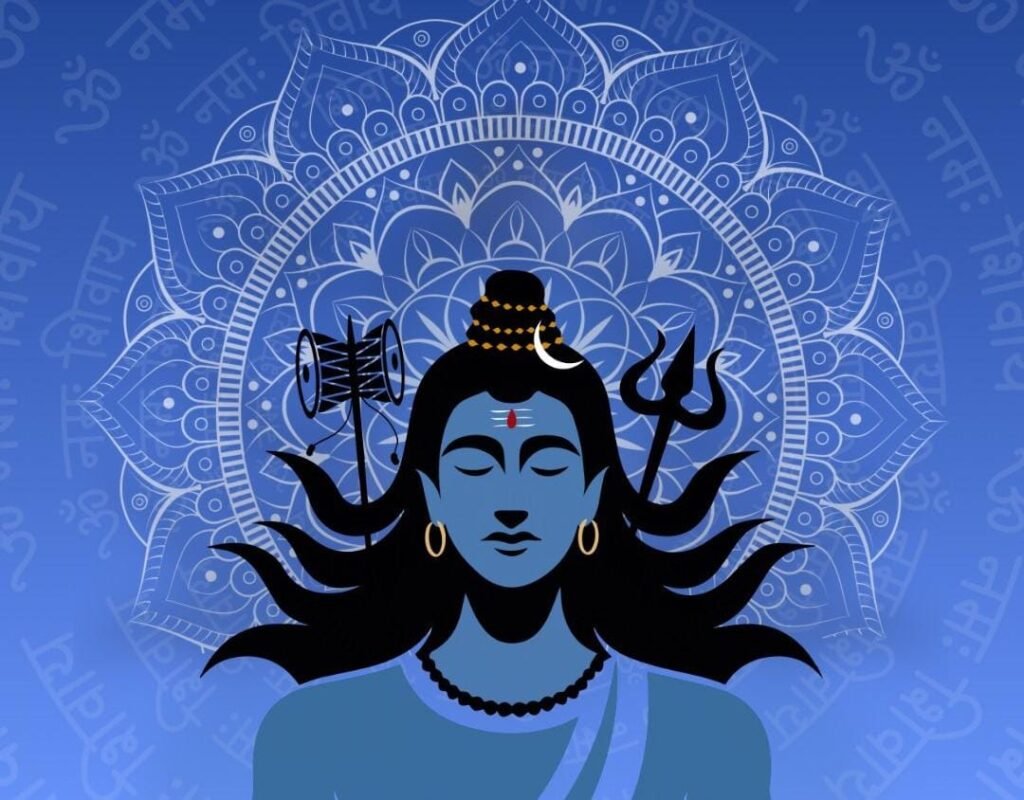
The festival of Mahashivaratri is traditionally observed on the Krishna Paksha Chaturdashi, the 14th lunar day of the waning Moon in the month of Phalgun according to the ancient Indian luni-solar calendar. Occurring on the night just before Amavasya (New Moon), it marks a moment when the Moon’s light is at its thinnest, symbolizing inwardness, stillness, and dissolution.
Far from being an arbitrary ritual date, this timing reflects a sophisticated awareness of celestial mechanics. The Hindu calendar tracks the angular relationship between the Sun and the Moon as seen from Earth. When this angle approaches zero degrees, the Moon is aligned with the Sun, the New Moon phase occurs. The night called Mahashivratri is celebrated just before this alignment, at a limited threshold between visibility and invisibility.
Lunar Timekeeping and the Nakshatra System
The Ancient Indian astronomers did not observe the sky merely for curiosity, they mapped it systematically. The Moon’s movement was tracked through 27 nakshatras or star systems (constellations) in the Milky Way Galaxy clearly visible from Earth, these stellar divisions along the ecliptic formed a sidereal framework for measuring time on Earth.
One such constellation known as Uttara Ashadha is associated in modern astronomy with stars in the constellation of Sagittarius when Mahashivratri is celebrated, however it is not fixed to a specific nakshatra each year, the broader nakshatra system reflects the precision with which ancient observers understood cyclical celestial motion in the sky.
This was not mythology replacing science, it was observation encoded in memory.
Uttarayana and the Solar Cycle
Every year, when the Sun enters Makara Rashi (sidereal Capricorn Zodiac), it marks the beginning of Uttarayana. Astronomically it is the Sun’s apparent northward journey. Geographically, the gradual lengthening of days in the Northern Hemisphere culminates around the March equinox. In the sidereal Hindu framework, however, this northward shift begins with the Sun’s transition into Capricorn Zodiac. Thus, Mahashivratri occurs during a period of increasing solar strength and late winter moving towards spring.
In the Indian seasonal calendar, February and March corresponds to Vasant Ritu, the spring season. It is neither intensely cold nor oppressively warm. Agriculturally and socially conducive for large gatherings, it has long been considered an ideal time for celebrations and marriages.
The festival’s placement within this environmental rhythm is not incidental. It reflects ecological intelligence.
Symbolism : The Union of Shiva and Parvati
Mahashivratri commemorates the sacred union of Shiva and Parvati. In literary symbolism, Shiva represents pure consciousness, still, unchanging awareness while Parvati represents Shakti, dynamic energy and manifestation. Their union signifies the convergence of stillness and creation, silence and expression, potential and form.
Placed at the threshold of the New Moon when external luminosity diminishes the symbolism deepens. The night encourages introspection. The ritual fasting and vigil align the body with cosmic quietude. The external sky mirrors the internal state.
Thus, cosmology becomes a contemplative practice.
Knowledge Preserved Through Storytelling
Ancient Indian civilization functioned largely through Shruti (that which is heard) and Smriti (that which is remembered), Knowledge including astronomy, ecology, seasonal science and timekeeping was often preserved through storytelling and ritual symbolism rather than written textbooks or scriptures in the very beginning. Festivals encoded environmental transitions. Myth carried memory. Ritual synchronized communities with celestial rhythms. Mahashivratri, therefore, is not merely the celebration of a divine marriage.
It is geography expressed through literature.
It is environmental science embedded in ritual.
It is seasonal transition articulated through symbolism.
Empirical observations and Abstract contemplations
In its original philosophical framework, Hindu thought did not treat empirical observation and abstract contemplation as opposites instead it was seen as complimentary to each other. Observation and symbolism coexisted. Astronomy informed spirituality. Ecology informed ritual. Cosmology informed metaphysics. In this synthesis, planetary motions were carefully studied, seasonal shifts were respected, and cosmic rhythms were celebrated. Festivals became civilizational markers aligning human consciousness with astronomical order.
Mahashivratri thus stands as a cultural expression of unity between sky and soil,
It is not merely a night of devotional observance, it is civilizational memory of astronomical awareness woven into ritual, ecology and metaphysics.