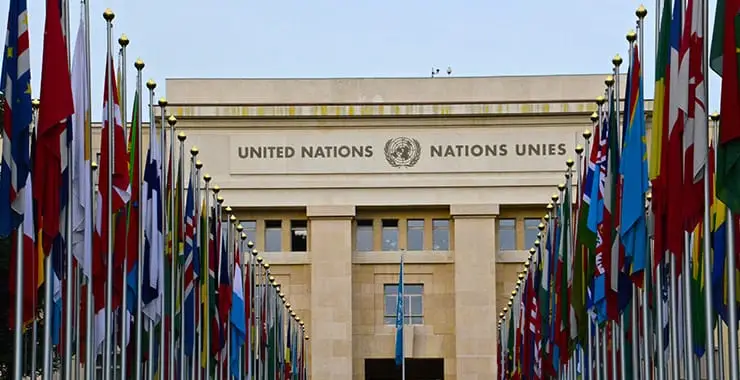
As competition intensifies between the United States and China to secure spheres of influence and access to strategic resources, the United Nations, once the temple of international law, stands stripped of its foundational ideals of security, peace, and human rights. The first casualty of this erosion is ‘Plausible Deniability’. Right after Venezuela, President Donald Trump declared, “We don’t need international law’ followed by the statement that “the United States will take Greenland whether they like it or not” with this, façade collapsed.
The European Union’s carefully cultivated “garden” now meets the bewilderment of a world sliding into anarchy that the ancient Indian strategist Archarya Chanakya named “Matsya Nayay” (which means bigger fishes eat the small fishes, where raw might prevails all morality), the “weeds of instability” will invade the pavement of peace, security guarantees and co-operation once upheld under Pax Americana. Today United Nations resembles a fallen tree, lifeless, vile, and fragile and from the Atlantic to the Balkans, Europe’s youth are being asked to prepare for war, while the world contemplates whether a conflict between Russia and the rest of Europe could spiral into a war within NATO itself. This fear is underscored by Danish Prime Minister Mette Frederiksen’s statement, “We will shoot first and ask questions later”.
As the European Union opens two strategic fronts, a grim realism emerges. Russia will keep Ukraine, and the United States will keep Greenland. Perhaps the true understanding reached between President Putin and President Trump during the Alaska peace talks [speculation].
The international order is not changing, it is merely exposing itself. When States once followed the framework of realism, they hid behind plausible deniability. The vigilance of the United Nations and the lingering ghosts of the World Wars made state aggression a matter of grave concern and moral condemnation within the international community. Today, those checks and balances have surrendered to the ‘Offensive Realism’ of the United States, evident in its actions in Venezuela and its overt claims over taking Greenland.
This trajectory only serves to further inflame China, which may soon move decisively toward Taiwan. While the United States seeks to control oil, China will seek to control semiconductors. And the story will not end there. In an era where power speaks openly, there is no longer a need to pursue a foreign policy of hypocrisy, when one can simply admit that saving face matters less than securing dominance.
Israel’s President Benjamin Netanyahu stated he would like to ‘taper’ Israel off US military, this is nothing unusual merely a preparation driven by apprehensions, as Henry Kissinger, former U.S. National Security Advisor, once observed that being a friend of the United States can be fatal. French President Emmanuel Macron said “India can create bridges and can balance the chaotic world”
At a time when many analysts are going haywire trying to gauge the direction in which the world is headed amid the noise surrounding President Trump’s decisions, India’s decision-makers are quietly navigating turbulent seas, guided by the helm of strategic autonomy and strengthened bilateral relationships.
Where the Non-Aligned Movement once lacked efficacy due to the absence of hard power, today’s India practices multi-alignment backed by credible hard power and pragmatic patience helping steer the world through a transition toward multipolarity, a duty that the United Nations and international law once pledged to fulfil.